The nexus between business environment and business performance of oil blending companies
Keywords:
industrial environment, task environment, business environment, competitive advantage, business performanceAbstract
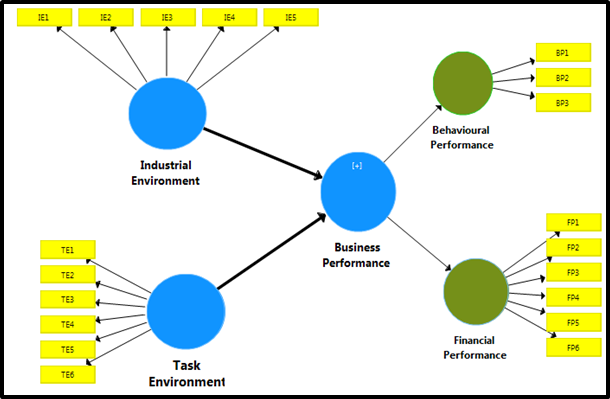
In view of the collapsing state of businesses in Nigeria, this study was carried out to examine the impact of business environment on business performance of oil blending companies in South-Eastern, Nigeria. It examines the relationship between business environment components and business performance of these oil blending companies. This study adopted a quantitative method approach. The population of the study comprises the staff, general managers, executive managers or managing director and customers of the 14 licenced oil blending companies in south-eastern Nigeria. The target population were the four selected oil blending companies which were purposively selected based on their year of establishment. Two hundred and sixty participants were selected using simple random techniques. A cross-sectional approach was adopted and data were collected using business environment questionnaire and business performance questionnaire” with the help of three research assistants. The returned and valid questionnaire were analysed using Statistical Packages for Social Science (SPSS) version 25 and Structural Equation Modelling analysis techniques (Smart PLS) version 3.2.6. The results showed a moderate level of financial performance of these Oil blending companies while the relationship between business environment and business performance is adjudged to be very high. Therefore, it was concluded that business environment is one of the major determinants of the business performance of oil blending companies in South-Eastern Nigeria. This research recommended that to be more strong and competitive in the market, Organizational managers must be strategically aware of customer needs and offer unique products and services that satisfy such needs.
Downloads
References
Adelegan, O. J. (2011). Infrastructure deficiencies and investment in manufacturing firms in Nigeria. Journal of Economics and International Finance, 3(9), 542-552.
Adenikinju, A. (2008). Efficiency of the Energy Sector and its Impact on the Competitiveness of the Nigerian Economy. International Association for Energy Economics, Fourth Quarter 2008, 27-31.
Adelegan, O. J. (2011). Infrastructure deficiencies and investment in manufacturing firms in Nigeria. Journal of Economics and International Finance, 3(9), 542-552.
Bagire, V., & Namada, J. (2013). Managerial skills, financial capability and strategic planning in organizations. American Journal of Industrial and Business Management, 3, 480-487. http://dx.doi.org/10.4236/ajibm.2013.35055
Barth, H. (2003). Fit among competitive strategy, administrative mechanisms, and performance: a comparative study of small firms in mature and new industries. Journal of Small Business Management, 41(2), 133-147.
Bauman, W. S. & R. E. Miller, (1994). Can Managed Portfolio Performance be Predicted? The Journal of Portfolio Management 20(4), 31-40.
Botten, N., & McManus, J. (1999). Competitive Strategies for Service Organisations.West Lafayette, Indiana: Purdue University Press.
Covin, J. G., & Slevin, D. P. (1990). New venture strategic posture, structure, and performance: An industry life cycle analysis. Journal of business venturing, 5(2), 123-135.
Crichton,E and Edgar, D. (1995) , “ managing complexity for competitive advantage : an IT perspective”. Intenational journal of contemporary Hospitality Management, Vol.7 NO. 2/3,PP.12-18
Dowell, G. (2006). Product Line Strategies of New Entrants in Established Industries: Evidence from the U.S. Bicycle Industry. Strategic Management Journal, 27, 959-979.
Eze, O. R., & Ogiji, F. (2014). Impact of fiscal policy on the manufacturing sector output in Nigeria: An error correction analysis. British Journal of Business and Management Research, 1(2), 31-54.
Gado, N. D., & Nmadu, T. M. (2011). The performance of textile companies in the North West Zone of Nigeria: The role of infrastructure as a resource. International Journal of Human Resource Studies, 2(1), 89.
Gupta, A. (2009). Organization External, Environment. http://www.practical-management.com/OrganizationDevelopment/Organization-s-External-Environment.html
Hair, J. F., Ringle, C. M., & Sarstedt, M. (2011). PLS-SEM: Indeed a silver bullet. Journal of Marketing Theory and Practice, 19(2), 139-152.
Hair, J. F., Hult, G. T. M., Ringle, C., & Sarstedt, M. (2014). A primer on partial least squares structural equation modeling (PLS-SEM). Washington DC: SAGE Publications, Incorporated
Jenkins, W. (2005). Competing in times of evolution and revolution: An essay on long-term firm survival. Management Decision, 43(1), 26-37.
Karagiannopoulos, G.D., Georgopoulos, N., & Nikolopoulos, K. (2005). Fanthoming Porter's five forces model in the internet era. Emerald Group Publishing Limited.
Kayode, D. J., Yusoff, N. M., & Veloo, A. (2016). Validating quality process management instrument for higher education using structural equation modelling. International Journal for Quality Research, 10(2), 341-354
Kwaghe, AK. (2001). Power failure and its effect on Business survival in Nigeria: A case study of small and medium scale Enterprises in Abuja, Journal of management and Research Development
Larossi, G. & Clarke, G.R.G. (2011). Nigeria 2011: An Assessment of the Investment Climate, World Bank, Africa Finance and Private Sector Development (AFTP), June 2011
Lee,C, Lee, K & Pennings, JM (2013), ‘Internal capabilities, external networks, and performance: a study on technology-based ventures’, Strategic Management Journal, vol. 22, no. 6/7, pp. 615-640.
Lusthaus, C., Adrien M. H., Anderson, G., Carden, F. & Montalvan, G. P.(2002). Organizational
Assessment: A Framework for Improving Performance. Ottawa, Canada: International Development Research Centre
Luqman, Oyewobi and James, (2016) Determinants of construction organisational performance: A partial least square-path analytic method
McGrath, M. E., Anthony, M.T., & Shapiro, A. R. (1992). Product Development: Success through product and Cycle-Time Excellence, Stoneham, MA. Butterworth-Heienhmann.
Obasan, K. A. (2014). The Impact of Business Environment on the Survival of Small Scale Businesses in Nigeria. Int. J. Manag. Bus. Res, 4(3), 165-170.
Ogawa, S., & Pongtanalert, K. (2013). Exploring characteristics and motives of consumer innovators: Community innovators vs. independent innovators. Research Technology Management, 56, 41–48. doi:10.5437/08956308X5603088
Palmer, A., & Bob, H. (2002). The Business Environment. London: McGraw-Hill Co.
Pearce, J. I., & Robinson, B. R. (2007). Strategic Management: Formulation, Implementation
and Control, 10th ed. Boston: Irwin McGraw-Hill.
Peng & Lai, (2012) : Using partial least square in operation management research. articles in journal of operation management. July 2012 DOI: 10.1016/j.jom.2012.06.002
Pertusa-Ortega, E.M., Molina-Azorin, J.F. and Claver-Cortes, E. (2010), “Competitive strategy, structure and firm performance.
Raduan, C .R., Jegak, U., Haslinda, A. and Alimin, I. I. (2009). A Conceptual Framework of the Relationship between Organizational Resources, Capabilities, Systems, Competitive Advantage and Performance. Journal of International Studies - Issue 12
Ramadan, H., & Ahmad, S. (2018). The impact of business environment on performance of manufacturing SMEs in Palestine: The empirical evidence. Asian Journal of Multidisciplinary Studies, 6(2), 1-6.
Ringle, C. M., Wende, S., & Will, S. (2005). SmartPLS 2.0 (M3) Beta, Hamburg 2005.
Savedoff, W. D. (ed.). (1998). Organization Matters: Agency Problems in Health and Education
in Latin America. Washington, D.C: Inter-American Development Bank
Terpstra, M., Kuijlen, T., & Sijtsma, K. (2012). An empirical study into the influence of customer satisfaction on customer revenues. The Service Industries Journal, 32(13), 2129-2143.
Tolbert, P. S., & Hall, R. (2009). Organizations: Structure, Processes and Outcomes. UK: Pearson.
Stalk, G., Evans, P. & Shulman, L. (1992). Competing on capabilities: The new rules of corporate strategy. Harvard Business Review. 70 (2)57-69.
Urbach, N., & Ahlemann, F. (2010). Structural equation modeling in information systems research using partial least squares. Journal of Information Technology Theory and Application, 11(2), 5-40.
Weerawardena, J., O’Cass, A., & Julian, C. (2006). Does industry matter? Examining therole of industry structure and organizational learning in innovation and brand performance. Journal of Business
Wang, Y. and Lo, H. (2012). Customer-focused performance and the dynamic model for competence building and leveraging: A resource-based view. Journal of Management Development, vol. 22.pp. 483–526.
Zehir, C., Şahin, A., Kitapçı, H., & Özşahin, M. (2011). The effects of brand communication and service quality in building brand loyalty through brand trust; the empirical research on global brands. Procedia-Social and Behavioral Sciences, 24, 1218-1231
Downloads
Published
How to Cite
Issue
Section
License
Copyright (c) 2024 Wilfred Okechukwu Ogbudinkpa, Ismaila Bolarinwa Kadiri, Issa Abdul Raheem

This work is licensed under a Creative Commons Attribution 4.0 International License.
JQM follows an open-access publishing policy and full text of all published articles is available free, immediately upon publication of an issue. The journal’s contents are published and distributed under the terms of the Creative Commons Attribution 4.0 International (CC-BY 4.0) license. Thus, the work submitted to the journal implies that it is original, unpublished work of the authors (neither published previously nor accepted/under consideration for publication elsewhere). On acceptance of a manuscript for publication, a corresponding author on the behalf of all co-authors of the manuscript will sign and submit a completed Copyright and Author Consent Form.